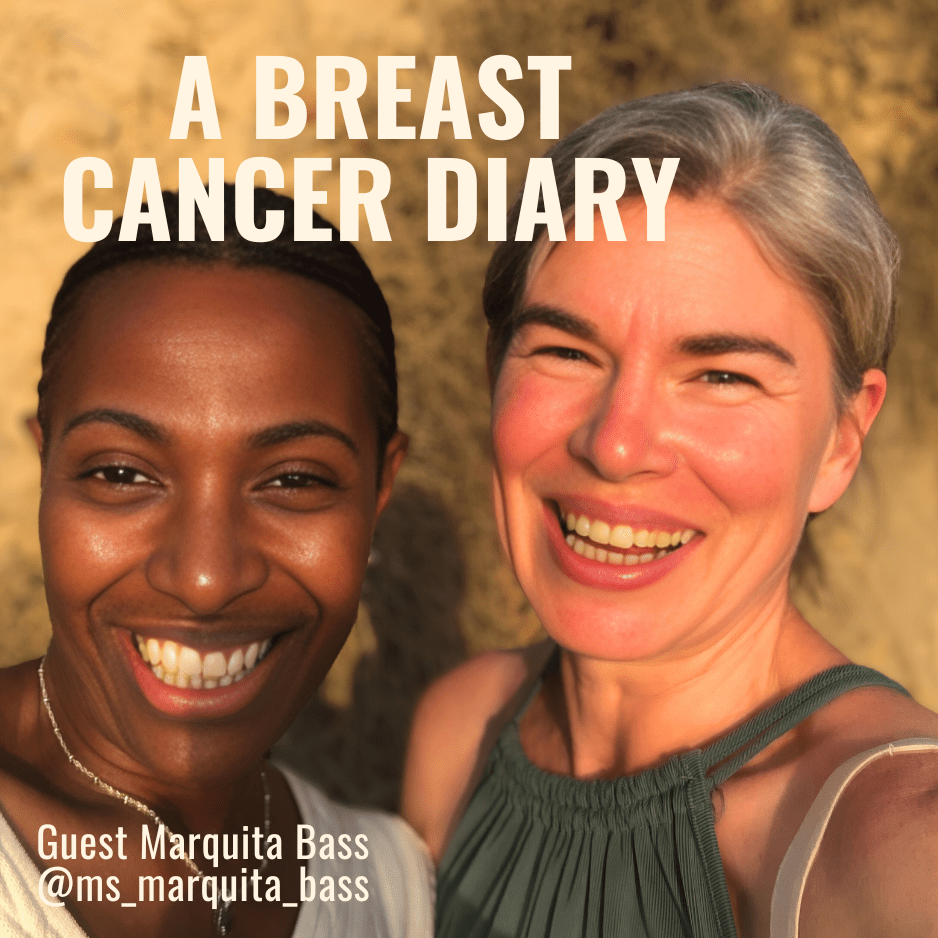
…and Subscribe on: APPLE PODCASTS – SPOTIFY – AMAZON
This episode gets into some murky medical territory so it’s important to note that your doctor is the only expert on whether chemo is for you. Personalized cancer treatment is still being tested in clinical trials at this time, but Marquita is one example among triple negative (TNBC) early stage breast cancer patients who might have taken chemo and is still apparently cancer free 12 years later to say that she has no regrets. Being an early stage survivor means that her choice to decline chemo was a less risky one than it would be for a later stage patient, but she has a lot to say about possible regrets with chemo in the context of TNBC.
Thanks for listening. Be sure to rate and review at your favorite podcast platform!
Listen and Subscribe on: APPLE PODCASTS – SPOTIFY – AMAZON
Or watch on YouTube: https://youtu.be/agbu6QjDiXs
Support my work by making a donation here:
https://liberapay.com/abreastcancerdiary/
This episode covers:
Marquita’s initial diagnosis of stage one TNBC
Marquita’s family history of TNBC and “head start” with family and friends who had it
Marquita’s discovery of Robin Roberts’ post-chemo diagnosis with MDS and what that meant for her
Marquita’s oncologist search, and the “regret matrix”
Marquita’s lifestyle efforts to avoid recurrence
Marquita’s book, Orange is the New Pink
Marquita’s advocacy on behalf of the Metastatic Breast Cancer Access to Care Act
Here’s a video summarizing what we know today about Triple Negative Breast Cancer and it’s subtypes:
For more about the new era of personalized medicine, here are some great YouTube videos to check out:
Episode Transcript:
This episode tells a very unique story of one patient whose medical choices and conclusions do not apply to all and don’t necessarily reflect the views of the host. Today’s guest, Marquita Bass, lives in the Atlanta area.
She’s a good friend of mine. We’ve been co ambassadors and advocates on many levels. She and I started learning about advocacy together in the FLAC community when she was my mentor when I was becoming a team leader for Stand Tall AFC just over a year ago. And then a couple of months later, we met a project lead in San Diego and were trained by the top scientists in breast cancer research from all over the country, in person together there in San Diego. And then just more recently, we joined the Public Policy Academy at National Breast Cancer Coalition as well and we’re learning about public policy advocacy. So we’ve kind of entered all three of the different areas of advocacy together and become really good friends in the process.
Marquita lives in the Decatur area of Atlanta, Georgia, and she is a business major. She has an MBA and works in the business realm with consulting. She’s a risk management specialist, or she was during the time of her diagnosis, and her risk management skills, skills have come in. really handy in the breast cancer experience as well, as you will hear from her story.
One day there in San Diego as we were learning together at Project LEAD, we were walking to the pool after an intense day in the classroom. She told me about her triple negative diagnosis experience and her struggle to come to terms with a treatment plan that would work for her after seeing her aunt die with the same diagnosis. Marquita’s insights blew me away. upbeat music playing. That day, and I remember thinking that I was so glad that she wrote her story down in her book for other TNBC diagnosed patients to read on the web page, promoting her book. Marquita says triple negative. Breast cancer is an aggressive subtype. With poor prognosis, there are many subtypes of triple negative breast cancer, and each one may respond differently to therapeutic agents. Yet, oncologists treat early stage TNBC as one disease in the clinical setting because standard of care says chemotherapy is the only option.
So Marquita, just to summarize for listeners, you were diagnosed with early stage TNBC in 2012, and that same month, your aunt passed from the same kind of breast cancer. How did your aunt’s experience affect the way that you face your own new diagnosis?
M:
Well, first of all, Kathleen, it’s awesome to be here talking to you, having this, like, chat with you, and thank you for this opportunity. Um, as you said, my Aunt Addie died within one month of me having my surgery.
Twenty years had passed from triple negative breast cancer. And their experiences colored my entire journey. But one thing that really affected my decision making was the day before I was scheduled to have surgery, Robin Roberts was diagnosed with MDS and that is a blood type of, um, challenge where, and it’s, and it’s the South, it comes from the South effect from chemo.
I was at the salon the day before my surgery, getting my hair done. And in the background I heard on the nightly news, um, someone saying Robert Roberts has been diagnosed with MDS and it’s from the side effect of chemo. And I, at that point, she was the only person I knew, uh, who had survived triple negative breast cancer.
Oh, wow. So, I was stunned. It had a huge effect on me. So, consequently, after I had my surgery, I started, um, researching triple negative breast cancer, the outcomes, chemo. I actually subscribed, I paid for a membership to the New England Journal of Medicine. And after my surgery for two weeks, because there’s a window when you have to decide if you’re going to take chemo or what your next step will be.
You know, after you get your pathology report, you go see the oncologist. And I research and research. I didn’t know at that time that triple negative breast cancer is not one. disease and it’s the only breast cancer that does not have a targeted treatment. Now things have improved since 2012. For example, now, um, if you are BRCA positive, you tend to have triple negative.
And, um, you know, there’s some things that are happening, uh, for triple negative. But, um, at that time, all triple negatives was treated the same. And I was mortified. I, um, found some research, which is the Vanguard study that says at that time there were six subtypes of triple negative caffeine. And surprisingly, each subtype responds differently to different chemo cocktails.
And when I went and, you know, took the research to my oncologist, she said, Oh yeah. And that’s only addressed in a clinical (trial) settings. So for you, it would be the standard of care. Okay. That’s Taxol, Adriamycin, and Carboplatin. And then she said, and you can decide if you want to do Taxol and Carboplatin, that’s TC, or if you want to do TAC.
I was, I thought to my mind, are you kidding me? So consequently, because, um, my tumor was early stage, and there was no vascular invasion, I decided to forego chemo. Now, I’m not saying that chemo is not good. Chemo saves lives. Absolutely. However, for triple negative breast cancer, I was reading articles that was, that said, uh, triple negative breast cancer and unmet medical need.
And these were recent articles, um, different subtypes of triple negative breast cancer respond to different therapies. And these articles were from peer review art, um, journals, um, despite higher rates of clinical response, triple negative, um, patients have a higher rate of distant recurrence. So consequently, I decided to, first of all, really understand my risk of recurrence.
And based on what I learned about my risk factors, recurrence, I made a decision to forego chemo, and that’s the hardest decision I’ve ever had to make in my life. I bet. Yeah, Kathleen, it was just hard.
K:
How did your doctor respond?
M:
Oh, I, you know, I went to three oncologists, . Yeah. And the oncologist that I started out with, she was, you know, she’s the one who told me, you know, you can do TAC or tc, and she was kind of lukewarm toward me.
Mm-Hmm. . Um, and. Also, she was my aunt’s oncologist and my neighbor’s oncologist. So I was thinking to myself, all the people you treat are dead. No, I’m serious. I’m kidding. I’m kidding. Most, my aunt, when she presented, she was metastatic, but, um, the oncologist that I ended up staying with, he recommended chemo.
He told me what his cocktail would be, but he’s the only, Oncologist Kathleen, who treated me as a whole person, and he respected my choice. Oh, wow. How did he articulate that? By telling me what he recommended. Okay. And then he told me that most patients that he would like hit in the head, they came in and wanted to refuse chemo.
But after our discussion, which was almost an hour, he had to respect my choice. Because you brought those journals with you and showed him. I had the journals there and he did, you know, and we talked about the journals and he taught me about something called absolute risk versus relative risk. Yep. And, uh, finally he said, you know, Miss Bass, I hear what you’re saying.
I have to tell you what we offer with the standard of care, but I will support you in your decision. And we talked about ways to That I could um become a long term survivor, you know, he recommended a vegan diet for me He said triple negative breast cancer patients do well on low fat diets I tried vegan for a while, but um that didn’t work for me now.
I’m plant based You know, I just it just I just looked like I was really ill But he worked with me and he respected me and he treated me with dignity I’m so glad. So I was fortunate because I know that doesn’t happen for a lot of patients, unfortunately. Are you still in touch with him? Um, actually he retired.
His name is Dr. Daniel Dubowski, but in 2020 when COVID hit, he sent me an email and asked me if I was okay. Yeah. So he retired and I still haven’t found another oncologist, um, that I go to regularly, but I was fortunate to have that type of support from the medical community.
K:
So you haven’t even needed an oncologist, it sounds like, are you in a place where you’re not working with an oncologist at all?
M:
He didn’t retire for two to three, I think it was three years. So I went to him for three years. And I went to another oncologist for a short period, but the only thing they do is the blood work. And the oncologist found and said, your internal medicine, your primary care doctor can do this blood work.
Oh, so they’re still doing, once a year, I still get blood work. Yes.
K:
Breast cancer markers?
M:
Actually, no–this oncologist doesn’t do the breast cancer markers. The other oncologist did but there’s a, um, some people say it’s not that effective. I don’t know. Right.
K:
It’s not popular anymore. Very suddenly in the last couple of years. They’re just refusing to do them, which leaves you with nothing. You don’t have any way to do ongoing surveillance, which is for me, really uncomfortable. I don’t know how you feel about that.
M:
But well, if you do a Signatera, I think there’s some other tests that you can do.
K:
That’s a great one. If you have enough of a lesion or tumor, um, to sample from, which I don’t, so, but do you, did you try it?
M:
Well, you know, actually, this is the first time that I’ve actually considered doing it. I’m going to go to an event on tomorrow and they will have representatives there and they said if you’re interested to take your insurance card, but I’m on the fence.
I’m going to tell you why I am a proponent of knowing things in advance but honestly, I don’t know what I would do if something was there. So I need to rationalize that in my mind. So I haven’t decided whether or not I’m going to do the test because they can detect tumor activity so early that it may not show up on a scan. If something doesn’t show up on a scan, Now your insurance won’t cover any type of treatments and what are you left to do?
K:
Right. And that’s why most doctors won’t use the signatera test because it leaves patients in a very anxious position if they test positive. I think some of us patients–probably you and I are in this group as questioners, are people who are researchers by nature, we want to know what’s going on in our body, even if insurance can’t do anything about it.
I think, you know, there’s, there’s other ways to, to go about getting scans. You can pay for scans out of pocket.
M:
You know, there’s other ways to show that it’s going on. If it is concerning enough, if it is alarming enough, if those tumor markers are high enough, yeah. But yeah, for me, I, I relate to you in this way of it’s, it’s hard to know what’s going on when you’re not doing any sort of markers.
K:
But how, how are you feeling about that? Like, how does it feel to not have an oncologist in your life right now? Does that feel okay?
M:
I feel okay because Kathleen, I live my life every single day as if I’m not going to have a recurrence. Yeah. And I am doing all I can do to be healthy. You know, I get blood work when I get the blood work, but I feel amazing.
K:
What are the other things you’re doing to avoid recurrence besides diet?
M:
The number one thing that I am doing to avoid a recurrence is managing chronic stress. I believe that stress is a silent killer. And I am also, I am living in the now. I live like yesterday was history. Today is a mystery.
Today is a blessing. And that’s, you know, the philosophy I have adopted, but I’ve had to also carefully learn how to stop multitasking as a project manager. That’s what we do. We multitask and I don’t even know if that’s effective and it’s just stressful, right? But I’m just trying to live a very healthy life.
Um, live. I’m grateful and thankful. And exercising. I have a rebounder. I exercise. My oncologist wasn’t huge on a lot of supplements. I don’t take a lot of supplements. I take some. I rotate supplements in and out. But I’m just living life and happy.
K:
Speaking of supplements and diet, was your oncologist an integrative oncologist or more of a traditional medical system person?
M:
He was, um, a traditional oncologist, but he was a vegan. Okay. Um, he listened to me. I was, I just, I lucked out, lucked out. I did. And we talked about things that he put on his, in his smoothie. And he was a regular oncologist, but he was open to, um, integrated, doing integrated things as far as my care.
K:
Sounds like it. Yeah. Yeah. That is so cool.
M:
He was definitely open to that.
K:
So unusual. And I’m sure unusual down in the South too. I think that’s a more traditional place. More conservative place.
M:
Very conservative. I have, like I said, I haven’t met another oncologist. Now, there are, uh, integrated oncologists, but I haven’t met another traditional oncologist who was like Dr. Dubowski. He just transformed my life.
K:
I want to go back and get some details from you because I know listeners are going to be curious. So you had Triple negative ductile, so you had a solid tumor?
M:
Yes.
K:
How large was your tumor?
M:
Oh, sure. My tumor was 1. 5, 1. 5 centimeters. And that’s probably the size of like a, an M& M. Um, and there was no vascular invasion. And what that means is when they did the surgery, none of the blood vessels that, uh, led up to the tumor.
K:
Okay. And there was no lymph node involvement, so there had, nothing had spread. So stage one, sounds like.
M:
I was stage one. Yeah. Absolutely.
K:
And you probably didn’t do radiation, or did you?
M:
I didn’t do, I had a double mastectomy. With implants at that time, and I was done. I didn’t do anything else.
K:
Yeah. Similar to my own story. Yeah, I can relate to that. So the triple negative though, I think most oncologists, if you told them you weren’t going to take chemo, that would be pretty alarming. How did you deal with the stress of finding an oncologist that could hear you and respect your decision? Um, how did you deal with that? Do you have any insights or, or advice for the rest of us who are dealing with that–some of that awkwardness?
M:
I don’t know if I dealt with it or not. I just you just got I just got through it Yeah, because every night I was just stressed out and it was just I was playing over and over in my mind what I was going to do I went to three oncologists the second oncologist, she was No! She didn’t really push me, but she definitely wanted me to do chemo and the last thing she said to me was “I feel so sorry for you,” and I was like, okay, you made me feel much better… but um, I think you just you can kind of just get through it because the stress is the stress level was so high. Yeah, and you know with anything, I just think you just have to work through it and you can’t give up and it’s very difficult because your doctors are looking at you sideways, your family members are looking at you sideways. And I’m thinking about my aunt, like she did everything she was supposed to do.
Some people, I want to say this, most women survive triple negative breast cancer. I want to make sure the audience hears that most women survive. It is not a death sentence. However, too many women do not survive.
K:
Thank you.
M:
And that’s the problem.
K:
Did your aunt have an early occurrence and then a later stage recurrence later?
M:
Yes. And my aunt’s initial tumor was smaller than my tumor.
K:
Okay. How long between?
M:
Uh, two years. Okay. So her journey followed the triple negative breast cancer saga: You’re diagnosed, you take the chemo within two to three years, that’s a recurrence. You do chemo again, and a lot of times the tumors are not, they’re, um, resilient to the chemo. What a lot of people don’t realize is chemo does not kill cancer stem cells. And that oftentimes may lead, you know, may lead to the recurrence.
So for a lot of women, that’s their story with triple negative.
K:
We’re still learning so much, right? Like, In the last 12 years since your initial occurrence, your initial stage one, have you been studying triple negative continually all these years?
M:
I still do, because I need to update the book. And I always go to attend virtually the, um, ASCO breast cancer conference and I’ve learned like some doctors now don’t prescribe the anthracyclines anymore.
They have a, um, a session on that, but early stage–so I’m learning so much and what I, the unfortunate thing that I’m learning is that we still don’t, we still haven’t made a whole lot of progress when it comes to early stage triple negative. Except for BRCA positive individuals, now, uh, they will use the PARP inhibitors as far as first line, that’s new. But what about the other women who have triple negative? And the subtypes have not been validated. So until you validate the subtypes, how can you develop a targeted treatment for something that you don’t know what’s causing the tumor? That is just amazing to me. And I have to share with you, Kathleen, until last year, I thought about this every single day. I did.
It was, it was like tormenting me until I decided, you know, I had to let it go, because any clinical trial or any research that does not start out with looking at the subtype of the tumor, in my opinion, you know, I’m not a PhD, but in my opinion, it’s flawed, because how can you treat and develop a targeted treatment for something that you don’t understand? That’s just common sense.
K:
And we’re learning about genetic markers, genetic mutations, things that change our cancer cells throughout time, throughout the years as well, which make a cancer so much more unique from woman to woman, from individual to individual. And so it’s, it’s a bright new day in terms of looking at all of these different aspects, not just subtypes, but genetic mutation pathways. There’s a huge amount to learn still and I think you knew that going in, because of your aunt. You knew that there was something not quite right, and looking at all those studies, you realized that change was happening. People were not sure about triple negative, and you needed to be unsure as well.
How do you describe–I know you’re a spiritual person–I call it intuition because I feel like we are born with this gift of intuition that we can listen to and we often ignore. How do you describe that in yourself, is that a spiritual process? Like, how did you get to the point where you could trust your own judgment and your own leanings both logically and maybe illogically because you know, the scientist sitting in the clinic with you, the doctor, is telling you standard of care is best.
How do you describe that process and what happened in you and how you took this very different path? Very few triple negative survivors have not had chemo, right? Like, you probably don’t need very many.
M:
I know some, but most people, um, do the standard of care and to answer your question: I was not at peace. So, and I don’t think there’s a right or wrong. The treatment that’s best for you is a treatment that gives you peace. And I was never at peace. Also, my oncologist did something that transformed my life. Dr. Debowski, he said he, he noticed that I was tormented, so he told me to make a “Regret Matrix.” On a regret matrix, so the treatments on the top, Chemo and no chemo on the left, you have your outcomes. Mm-Hmm. No recurrence. And recurrence. So if you take chemo and there’s no recurrence, you’re a happy patient that you did the, you know, you did the treatment. No recurrence? You’re happy. If you do chemo and there’s a recurrence maybe then a sad patient…. This is for me because the matrix may the outcomes may be different for everybody else, but for me if I had taken chemo and there was a recurrence, I would probably been very sad. No chemo and no recurrence means a happy patient. No chemo and recurrence and this is the most important decision point.
Will I be at peace with my decision? And he said only you can make that decision. In my mind my choice was I would be at peace because I followed my instincts and I was at peace. So I was willing to take that risk. Everybody’s not able to do that, but that regret matrix was how I finally decided that I’m going to forgo chemo and I’m okay.
And I told him something, he probably thought I was crazy. I told him, I said, I’m going to die under my terms.
K:
And you, not every patient has the insight of a recent experience of a family member dying after having chemo and then two years and then a recurrence. At that point, With that kind of grim outlook, you don’t have much to lose, right?
Like it’s very different when you have that personal experience of a family member going through chemo and then it not being worth it in the end for her. …So but you had a ton to lose NOW, looking back, you have 12 years of a beautiful functional life, right?
M:
Yeah, I do. I do. But I have to, I have to share this because I have to be forthcoming: I was going to do chemo despite my aunt’s experience until I learned about Robin Roberts.
So she was the only person I knew who was still alive from triple negative. Now I know other people, but she was it. And if it wasn’t the pivotal month, I mean, um, the event for me was the MDS diagnosis. Right. And that propelled me to really do a lot of research. I didn’t know triple negative was not one disease. I didn’t know that each subtype responds differently to the different types of chemo cocktail. I didn’t know any of that. So her experience propelled me to learn about this disease. What is this triple negative? What is this chemo? And what are your options? So I think it was a combination of things, but I was, and I say that because also a person’s biology or physiology can determine their outcome.
I was really healthy. Unfortunately, my aunt was not healthy. She had some co-morbidities. And sometimes that can impact your success when it comes to treatments, so I had to take that into account, but when I saw Robin Roberts, I saw me, I saw someone who was healthy, who was thriving, and I was like, okay, if she can get through it, I can get through it. I don’t know. It was just a turn of events. And I, you know, I hate she had that diagnosis, the MDS diagnosis. But her diagnosis saved my life.
K:
It factored into your regret matrix, right?
M:
It, did. it, one hundred, one hundred percent. Changes the game. Yeah.
K:
So looking back at where you were, 12 years ago when you got your diagnosis, is there anything that you wish you had known that you do know now?
What would you say to yourself?
M:
Oh, wow.
Anything that I wish I had known?
K:
You knew a lot.
M:
I didn’t know how difficult it is to get the research community to do what I think is common sense. There are a lot of things that go into research, like who gets the money. There’s a lot of politics.
We learned a lot about that when we went to Project LEAD. I didn’t know that. I didn’t know you know about clinical trials, and I didn’t know how vital it is, Kathleen, to understand how to read a clinical trial. For example, who sponsored the trial? How to interpret the trial? The data, I didn’t know all of that, like relative risk.
K:
Yeah, that, that concept alone is huge.
M:
Women make treatment decisions based on relative risk. And I try to just tell people, do your research and also talk to your oncologist. Because each oncologist may prescribe a different cocktail. I’ve met women with triple negative and their oncologists use older chemotherapies and they’re doing really well, really well.
So that’s just a lot. I didn’t know the politics of research. I didn’t know, you know, I just didn’t know.
K:
Yeah. In retrospect, I kind of don’t want to know. It’s really sad.
M:
It’s a sad story. It’s very sad. And I really, I’ve had to give it up because you can only do what you can do. Yes. Yeah. And I didn’t know. I knew it was important to be on top of your health.
But now I tell women: “you’re the CEO of your health.” If it’s breast, I don’t care what it is, breast cancer, you know, your children’s health or whatever. You are the CEO. And you, if you want to–I want to qualify that because some women are okay just following doctor’s orders and there isn’t anything wrong with that, nothing at all, that works for them. But if you are an individual who really wants to be involved and understand, do you know how many women I’ve met, Kathleen, who cannot tell you what type of breast cancer they had? I had breast cancer and I did this and now I’m okay. And I’m thinking, well, what type? And, but, but that’s okay. Because the one thing I do is respect a person’s right to be who she is. I respect that.
K:
Well, and we only know what our oncologists tell us, so it’s not, we aren’t to blame if we don’t know the details.
M:
Or if we don’t want to, because this diagnosis, Kathleen, can be so devastating for some women. They just want to get through it. Tell me what to do, and I’m going to do it.
But, um, I tell women, you are the CEO of your health.
K:
As the CEO of Your Health, are you, I mean, you’ve been studying TNBC continually. Do you feel like you would know what to do in terms of helping your doctor make a plan now if you did get a recurrence? Like, do you have a sense of what that looks like?
M:
Oh yeah. Um, I would definitely have my tumor tested, even if I had to pay for it. Number one, because you can’t treat what you don’t know what’s driving it. I would definitely have my tumor tested. Is there, is there a technology that you’ve leaned towards in terms of the testing? I think it’s C. A. R. I. S.
There are a lot of tests, and I’m only familiar with C. A. R. I. S. because of my friend, uh, Melissa, who lives in Philadelphia. You just have to find out. The more you know, the better choices you can make. And I would definitely find out the biology of my tumor, even if I had to pay for it myself.
K:
Yeah. Okay.
Last question. I wanted to ask you about the title of your book. The poster for those who are watching on YouTube, the poster is behind Markita on the screen. It’s called Orange is the New Pink. And it’s got a beautiful painting of a navel orange on the cover. And I just wondered, I’ve always wanted to ask you this question and I saved it for the podcast to ask you, what is the meaning of the color orange to you?
And why is it the new pink in your life?
M:
You have to buy the book.
It’s in there. It’s in there. You have to buy the book, but I will say this. My oncologist. He discovered the orange for me. Okay. Not the title, but the orange, um, on my body element in your story. Okay. He discovered the, and I had just gone to another oncologist and he was examining me and he looked at my hands. I will share this: He looked at my hands and he said, do you notice how orange your hands are? That’s, that’s one of the drivers for my title.
K:
Yeah. Tell us a little bit, just a quick summary of your book. Is it heavy in the science? Because I know you are a researcher and you’re very much attuned to the science.
Is it, is it got a lot of science in it or is it mostly story? Is it a lot of people’s stories or mostly your story?
M:
It’s a combination, but the science is very easy to relate to. Like I will talk about a study and talk about it in layman, layman terms. But it’s a, it’s a book. It’s about my journey. Also this book is not just for women who’ve had triple negative breast cancer or breast cancer.
Okay. This book is to promote awareness to maybe prevent you from getting breast cancer. So it’s educational. And I start out talking about what is breast cancer and the subtypes and then I talk about my journey, what are the things you need to do right after a diagnosis? What, what are your decision points, understanding your, your cancer type, your biopsy, getting a second opinion, a surgeon.
And I, in, uh, the last chapter, I talk more about triple negative treatments and things that I think, um, should happen. Okay. Yeah, but it’s a, you know, it’s, you know, my book will make you laugh, cry, and think. Mm hmm. That was my purpose.
K:
Beautiful. Yeah. So I have one more question. I want to ask you just briefly what, I know you’re a super strong advocate for all kinds of breast cancer survivors, all of us as a whole.
What is the thing that you’re doing in the advocacy space right now that you feel most strongly about?
M:
I am trying to get our two senators in Georgia and other senators to co sponsor the metastatic breast cancer access to care act. I’m very passionate about that. I went to D. C. in May, and we had a, um, leadership advocacy conference.
I actually met with, um, representatives and senators. And this is a bipartisan deal. You know, I’m not on the left. I’m not on the right. Um, you know, I’m not a person that’s big on entitlements. But this is not an entitlement. This is a right. That’s it. These individuals have paid into Medicare and because they need it sooner than later because of being having a metastatic diagnosis, that’s their right.
We’re not asking for an entitlement.
K:
No, they’re already categorically eligible. It’s just the waiting period. That is insane.
M:
It’s two years and It’s insane and I’m really disappointed in all the senators in Georgia. I’m going to say it because they have not co sponsored this bill. Yeah, um, and I’m sure there are other sentences, but this is a bipartisan bill. Again, it’s the “Metastatic Breast Cancer Access to Care Act” and if you’re listening to this reach out to your representatives your senators. Ask them to co sponsor this bill because it could be you. I actually have a male friend who cannot, his wife cannot retire because of the waiting period they depend on her health insurance because of the waiting period for medicare. And he’s metastatic, close friend. So that’s what I am most passionate about right now.
K:
And for listeners who are brand new to this concept, metastatic is stage four. It is the non curable, progressive type of cancer that the type that tends to grow pretty aggressively and be untamable at some point. A lot of folks can live, you know, 10 or more years with it, but it is very aggressive and it is a legitimate reason to be not working and to be on Medicaid. So I think we’ll keep it to that, Marquita. This has been a nice long talk and I just want to thank you, my friend, for being here today.
And, we’ll hope to have you on again to talk about some of the projects that you’re doing in the advocacy space. Because this was just the beginning of that iceberg. I wanted to tell your personal story first and then talk a little bit more about advocacy next time. So we’ll have you on again.
M:
Thank you Kathleen, for the opportunity to chat with you. This has been very helpful and really um, cathartic for me to talk about my experience. And yeah, it has been. I’m trying not to cry because every time I think about my aunt and everything, but I share my story because I want to help as many other women as possible.


Leave a comment